Architecture
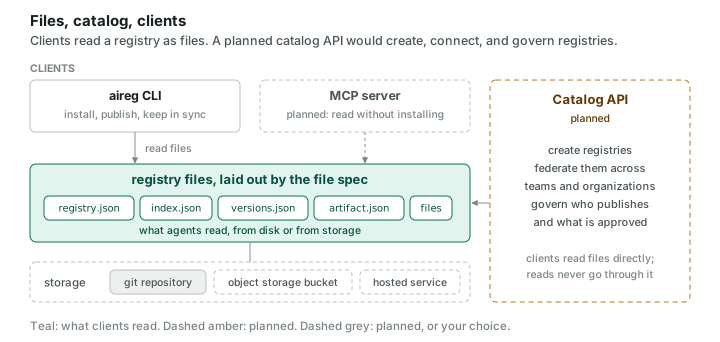
A registry is a set of files: the artifacts themselves and the metadata files that describe the registry and each artifact. Clients read a registry as files. A catalog API is planned, to add governance and federation across registries.
Refer to the file spec for more detail.
The file spec
Clients read a registry as files. The file spec defines their layout, so a folder, a git repository, or an object storage bucket holding those files is a complete registry. Agents read artifacts from the file system, not from a server. aireg reads folders and git repositories; no client reads an HTTPS root yet.
Anatomy of a registry
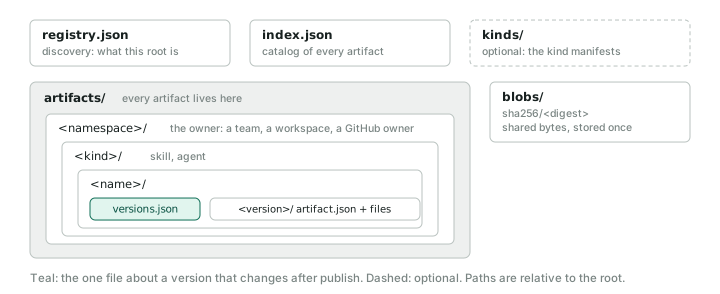
A registry that follows the specification is a root (a directory, a git repository, or an HTTPS origin) that contains the components below. Each path is relative to a root.
registry.json. The discovery document. It describes the registry itself: the format version it follows, its name and slug, its URL when it has one, how to authenticate, where blobs live, and the kinds of artifacts it contains. A kind is simply a type of artifact, such asskilloragent.index.json. The catalog. One entry per artifact in the registry, with its latest version, digest, and status, so a client can browse or search the registry in one read.artifacts/directory. Every artifact lives here, each in its own directory.- Each artifact's path has the form
<namespace>/<kind>/<name>/<version>, for example the engineering team's pr-review skill (v1.2.0) would be stored inengineering/skill/pr-review/1.2.0/. - A namespace is the owner inside the root: a team, a workspace, or a GitHub owner, such as
engineering/. - Each artifact directory contains a
versions.jsonfile, which lists the artifact's versions, names which one is latest, and holds each version's status. It is the only file about a version that changes after publish. - Each version has its own folder, which never changes after publish. It holds the artifact's own files, such as
SKILL.mdfor a skill, and anartifact.jsonfile with the metadata for that version: its identity, the files it contains with a digest for each, the kind's ownspec, and its relationships to other artifacts in the registry.
- Each artifact's path has the form
kinds/directory (optional). Where a root keeps the manifests thatregistry.jsonpoints to, one JSON Schema per kind, such asskill.jsonandagent.json. The manifests can live anywhereregistry.jsoncan reach.blobs/directory. Content stored once by its sha256 digest, for files that are large or shared between versions. A file listed inartifact.jsonwithout a URL is fetched from here.
Together, a registry looks like this:
registry.json                                # discovery: kind, format_version, name, slug, capabilities, url, auth, blob_url, kinds[]
index.json                                   # catalog: every artifact with its latest version, digest, status

artifacts/                                   # every artifact lives here and nothing else does
  <namespace>/                               # the owner inside this root: a workspace, a team, a GitHub owner
    <kind>/                                  # skill or agent
      <name>/
        versions.json                        # one entry per version: digest, status, yanked; names latest
        <version>/
          artifact.json                      # the envelope: metadata, files[] with digests, spec, relationships[]
          SKILL.md                           # the kind's native files, byte-identical to what the author wrote
          references/...

kinds/                                       # optional: the manifests registry.json points to
  skill.json
  agent.json

blobs/
  sha256/
    <64 hex>                                 # large or shared content; descriptors without urls resolve here
Clients
aireg CLI
aireg, the CLI in this repository, creates registries, publishes to them and installs from them, and keeps installed artifacts in sync with harnesses like Claude Code and Codex. See Quickstart and Use cases to get started.
MCP server
An MCP server is also planned, so agents will be able to read a registry's artifacts directly with nothing installed.
Concepts
Root. The place relative paths resolve from: a directory, a git repository, or an HTTPS origin with an optional prefix. One root is one registry, and it belongs to one organization.
Namespace. The owner inside a root: a team, a workspace, or a GitHub owner. It is the first segment of every ref.
Artifact. A named thing in a registry, identified everywhere by its ref. Each version is an envelope that wraps the artifact's native files unchanged and adds identity, a digest per file, the kind's spec, and outbound relationships.
Kind. The type of an artifact, such as skill or agent; mcp_server is planned. Each kind is declared by a manifest, a JSON Schema for spec with x-registry- keywords naming the files the kind requires and the edges it may declare. Relationship restrictions and search or governance annotations are not enforced by the CLI. registry.json lists the kinds a root holds. A kind wraps a format that already exists, such as SKILL.md, AGENT.md, an A2A card, or the MCP registry's server.json, and never invents a second one. The registry grows by adding a manifest, not by changing the format. See the kind manifests.
Version and ref. namespace/kind/name@version, for example engineering/skill/pr-review@1.2.0. Without @version a ref resolves to latest. Semantic versioning is recommended and is required for range resolution.
Status. One of draft, pending_review, active, blocked, deprecated, archived, held in versions.json. yanked is a separate flag. A pinned install keeps resolving after a deprecation or a yank. aireg warns that the version it keeps is yanked whenever it reads the registry to install, update or sync; an install with everything already in place reads no registry, so it says nothing.
Content digest and catalog digest. The content digest identifies the bytes of a version and never changes. The catalog digest identifies the version plus its mutable state and moves when that state does. See Digests.
Relationship. An outbound edge from one version to another ref: depends_on or supersedes. Installing an agent resolves its depends_on closure.
Publisher. The one writer of a registry's pointer files. In a repository, whoever runs aireg registry index, by hand or in CI.
Client. Anything that reads a registry: the aireg CLI, an MCP server, a CI job, or a harness.
Host document. What /.well-known/registry.json returns when a host serves several roots: the roots the caller may see, and how to authenticate. See Host discovery.